


Following the guidance of the map software on her mobile phone, Lisa quickly found the Luckin Coffee on the corner. Click the automatic parking button on the car computer, and Jack's new energy vehicle efficiently completes the parking space search and automatic reverse parking.
Following the guidance of the map software on her mobile phone, Lisa quickly found the Luckin Coffee on the corner. Click the automatic parking button on the car computer, and Jack’s new energy vehicle efficiently completes the parking space search and automatic reverse parking. This is inseparable from the critical role of the GNSS system. The GNSS system has gradually become a key part of today’s infrastructure. It is not only for positioning and navigation but also in various application scenarios, such as autonomous driving, unmanned equipment, robots, smart cities, IoTs+, and precision agriculture, which have penetrated every aspect of our lives. These applications are realized based on the GNSS receiver accurately receiving the signals broadcast by GNSS satellites. Still, the satellite signal is very weak and easily interfered with. The noise and interference received will affect the accuracy of the solution and even make the receiver unable to work correctly.
1. Bustling and Crowded World of Electromagnetic Signals
In the GNSS system, the satellite signal is modulated by spread spectrum, reducing the satellite’s transmitting power. After long-distance transmission, the signal reaches the receiver antenna and is very weak. The power of GNSS signals received on the surface is typically -140 dBm, which is 20 dBm lower than the background noise power. According to the formula 1 dBm = 10 × log(P/1 mW), it is about 100 times weaker than other radio background noise. You cannot even “hear” the satellite signal with a normal antenna and receiver over the background noise. The radio frequency spectrum is filled with many existing bands, including VHF, FM radio, microwave, Bluetooth, Wi-Fi, 3G, 4G LTE, and the increasingly widespread 5G, making the electromagnetic world even more active.
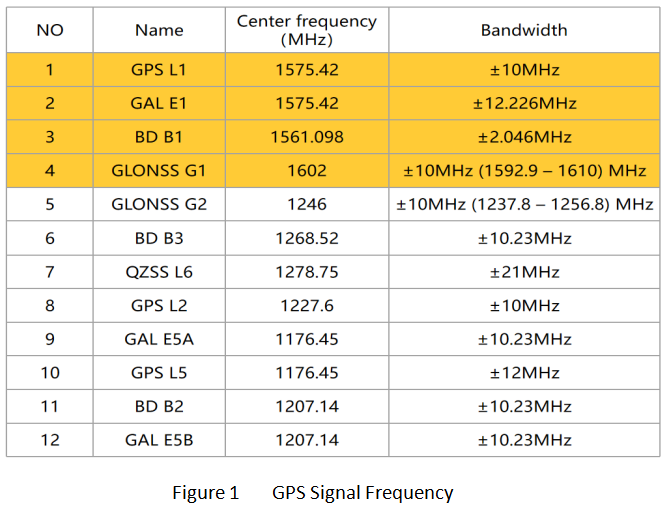
Even though GNSS signals have their inherent frequencies, they can still be easily mixed with various RF signals. These signals are either close to the frequencies of GNSS signals or have powerful signal strengths. Some interference signal frequencies even penetrate the GNSS frequencies and mix with GNSS signals, forming interference signals that have a more severe impact and are more difficult to distinguish. For example, the center frequency of the L5 band is 1176.45 MHz, which is also the frequency band used by DME (distance measuring equipment) and TACAN (tactical air navigation). These radio beacons are deployed near airports and emit high-power radio pulses, which may interfere with GNSS receivers using GPS and Galileo signals in this band.
2. The Impact of Interference Signals
Despite various signal interferences, professional GNSS receivers can still obtain GNSS signals from complex background noise. The performance of the GNSS system mainly depends on the availability of satellites and the accuracy of satellite positions. For higher reliability and higher accuracy, most current GNSS receivers are multi-constellation, multi-band, or even full-constellation and full-band. When using multi-constellation combination positioning, the fixation rate and reliability of ambiguity resolution are significantly improved, and positioning accuracy can be improved by more than 20% compared with using a single constellation. When fewer satellite frequencies are interfered with, the redundant design can still ensure that the GNSS receiver has high accuracy. However, positioning accuracy is difficult to guarantee when an interference source affects multiple frequencies within a GNSS frequency band or affects the entire GNSS frequency band.
For example, a dual-frequency receiver of GPS and GLONASS has to switch to the dual-frequency RTK mode of GPS when the G2 band of GLONASS is wholly interfered with. This may reduce the accuracy of the measurement results. If both the GLONASS G2 and GPS L2 signals disappear, the receiver has to switch to a single L1 band RTK, DGPS, or even single-point mode. For application scenarios that rely on RTK solutions with an accuracy of a few centimeters, falling back to non-RTK modes, such as pseudorange-code differential, is not acceptable.
3. Different Forms of Interference
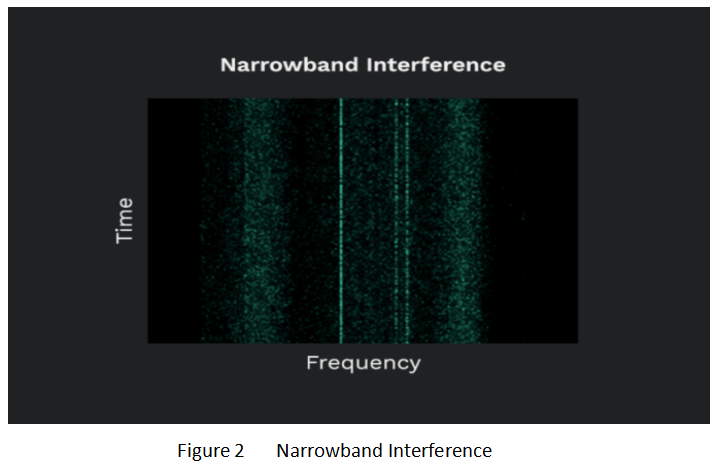
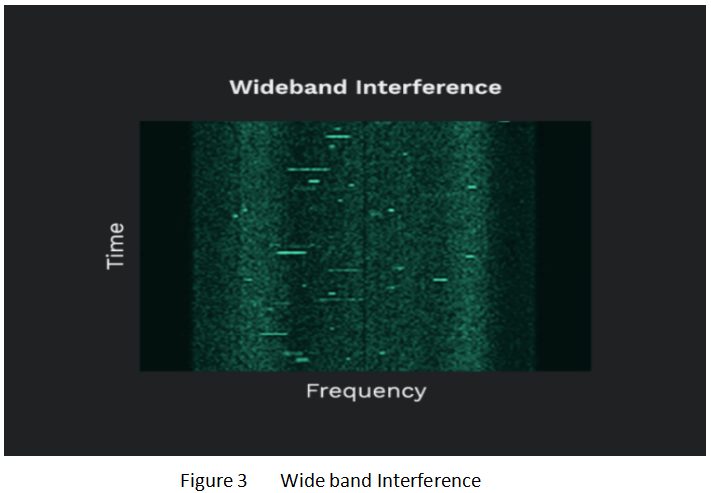
There are many sources of interference, mainly various electronic and electrical equipment, from ordinary equipment in our daily lives and work to special equipment at airports, military facilities, signal towers, and so on. Interference can be classified in various ways, including human-made and non-human interference; suppressive, deceptive, and distributed three-dimensional types; and other categories. Interference patterns include narrowband signals, wideband signals, continuous-wave single tones, continuous-wave frequency sweeps, and continuous-wave pulses. Among them, narrowband interference has the most significant impact on satellite signals. Narrowband interference is generally defined relative to the bandwidth of the received signal and is typically within 10% of that bandwidth.
Anti-Interference: Tersus in Action
1. The Principle of Anti-Interference
Tersus has conducted extensive research into anti-interference, including implementation across different links such as the antenna, RF, and baseband. Research on anti-jamming technology using signal processing includes spatial filtering, time-domain filtering, frequency-domain filtering, and joint filtering.
Spatial filtering technology mainly uses antenna arrays and adaptive algorithms to identify and filter interference. By applying different weights to different antennas, a beam can be formed in the direction of signal incidence (beamforming), or the signal can be suppressed in the interference direction to minimize the signal output power in that direction (nulling). Beamforming requires more signal-prior information and is more complex to implement than nulling technology. The number of interferences that spatial filtering can resist is related to the number of antennas used.
Time-domain filtering technology is divided into linear and nonlinear methods, both of which have a good suppression effect on narrowband interference. It mainly uses the before-and-after correlation of narrowband interference signals, uses past signals to predict the received signal, and uses adaptive algorithms to filter the interference signal from the received signal. Time-domain filtering is a transverse filter based on an FIR structure, which is easy to implement in engineering, but its iteration time is long and its ability to suppress changing interference is limited.
Frequency-domain filtering technology transforms the time-domain sampling signal into the frequency domain, analyzes the signal spectrum, and suppresses parts that do not conform to the signal spectrum characteristics to filter out interference signals. Because the navigation signal is a Gaussian white-noise signal when received, its amplitude is flat within the frequency band. When narrowband or single-tone interference occurs, the interference spectrum can be easily distinguished in the frequency domain, thereby suppressing the interference. In the early days, the Fast Fourier Transform (FFT) was used to suppress narrowband interference in spread-spectrum communications. Later, the Discrete Fourier Transform (DFT) technology was applied to frequency-domain filtering.
The main idea of joint-domain filtering is to combine the techniques described above to achieve better filtering effects. The main approaches include space-time-domain filtering, space-frequency-domain filtering, and time-frequency-domain filtering. However, implementation is relatively complex and engineering deployment is difficult.
Among the anti-interference algorithms mentioned above, spatial filtering requires a multi-antenna design. For measurement receivers, antenna phase-center accuracy significantly impacts the final measurement results. The phase center formed by multiple antennas is relatively complex, and its accuracy cannot be guaranteed. In addition, multiple antennas increase the receiver size, which is not conducive to manual outdoor operations. Therefore, spatial anti-interference algorithms are not suitable for measurement receivers. Time-domain filtering is simple to implement, but its iteration time is long. If the interference signal changes quickly, anti-interference capability is reduced. Joint-domain filtering is complex and not conducive to engineering implementation.
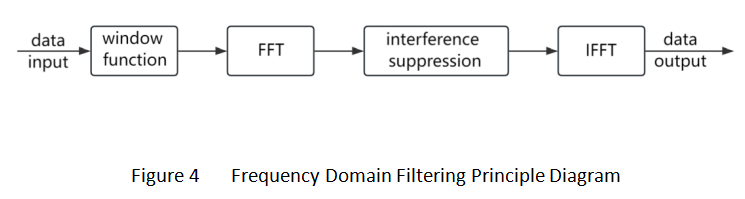
Tersus balances anti-interference requirements with engineering implementation. It adopts frequency-domain filtering technology, combined with self-developed advanced algorithms, to automatically detect and filter interference signals. After the antenna receives the RF signal, digital signal demodulation is performed by shifting the signal band through the local oscillator and sampling with the ADC. FFT is performed on the sampled signal to transform it into the frequency domain. Points in the frequency domain that are higher than the normal signal-amplitude threshold are detected, abnormal points are forced to zero to remove the interference signal, and IFFT is finally performed to restore the signal. The schematic diagram is shown below.
2. Hardware Guarantee
Tersus engineers have been engaged in research on GNSS signal anti-interference for nearly 10 years and have accumulated extensive relevant experience. They have core technologies and algorithms in the field of anti-interference. From hardware, software, and algorithms to personalized support, Tersus provides full-process GNSS signal anti-interference support.
To deal with interference signals of various forms and sources, all forms of interference must be considered throughout the architecture, design, development, and use of a GNSS receiver. The receiver components must work together. From the analog design of the RF front end—the part of the antenna and receiver that captures and processes high-frequency signals—to digital signal conversion and the use of digital filters and algorithms, every stage must contribute to combating interference sources effectively.
Targeted receiver antenna design, the independently designed and developed Antares baseband chip using a mature 55 nm process, powerful board-design and integration capabilities, and targeted combination filters provide strong hardware support for the anti-interference capability of Tersus OEM boards.
3. Algorithms and Software
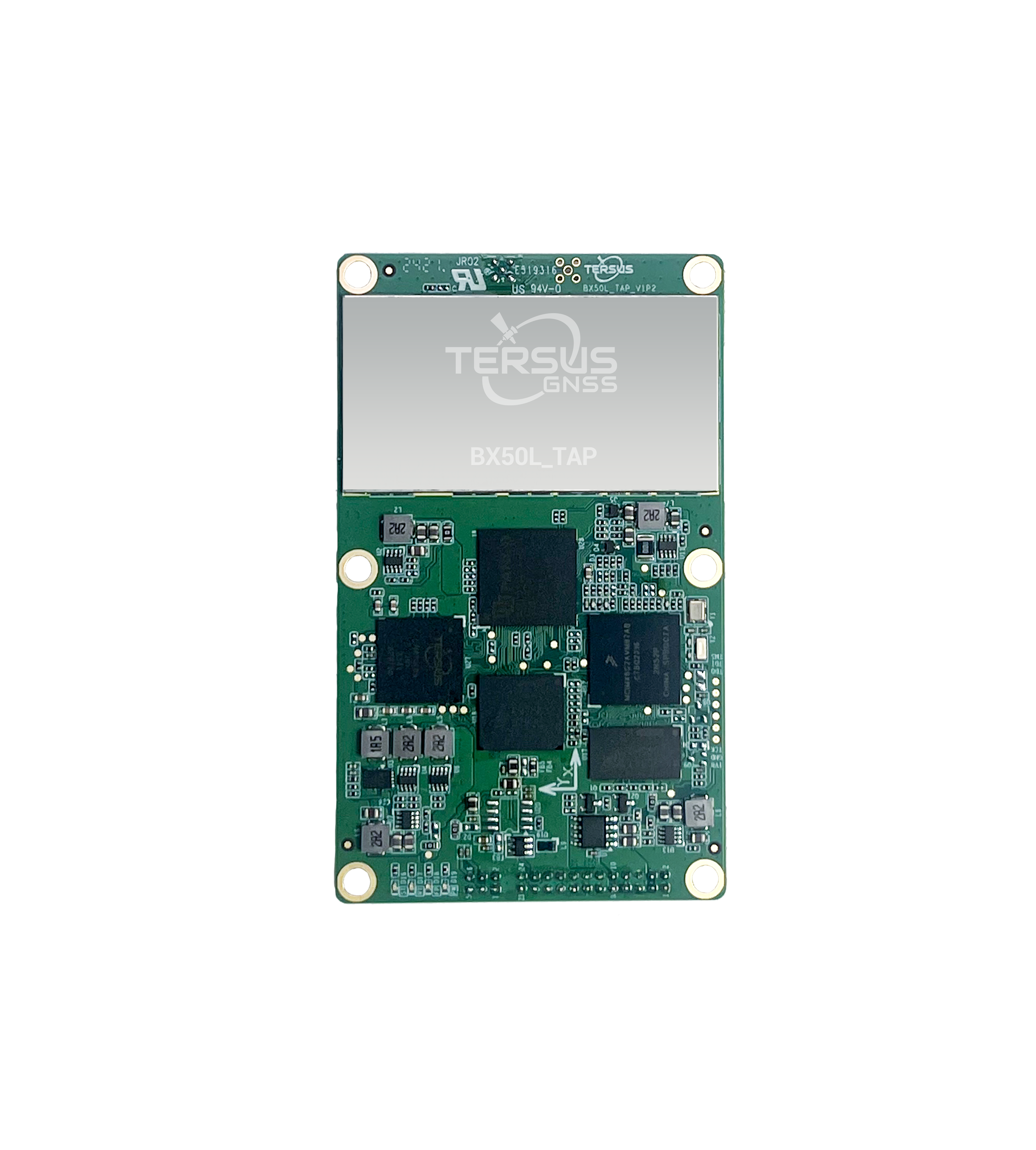
Based on its hardware, Tersus has also conducted dedicated research and design on algorithms and software to combat interference. The advanced frequency-domain anti-interference algorithm can detect and eliminate interference signals in real time. On the BX50M-TAP and BX50L-TAP boards, the anti-interference algorithm integrated into the board works automatically and removes interference signals that exceed the threshold.
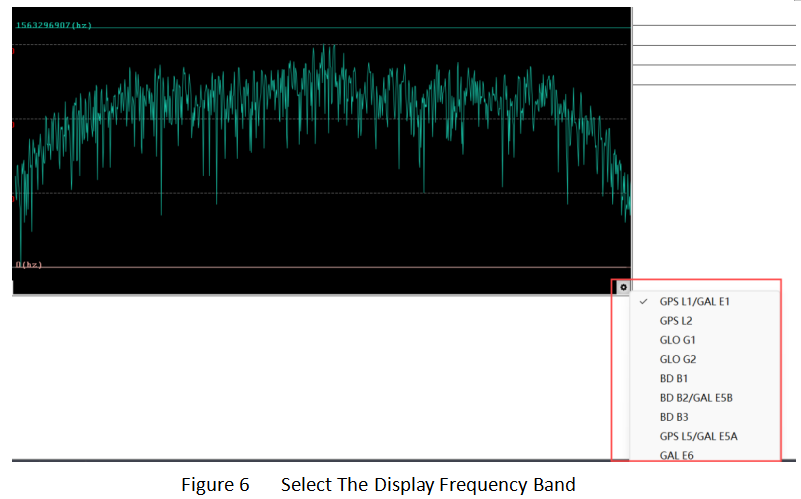
In addition, the board scans the signals of each frequency band in real time. Through Tersus GNSS Center software, users can view the board’s scanning status for signals in each frequency band, allowing them to understand the interference status of their environment in real time. Use the button in the lower-right corner of the software RF signal display window to check each frequency band, view signal conditions for GPS L1, BeiDou B1, GLONASS G1, and other frequency bands, and scan for interference sources on site.
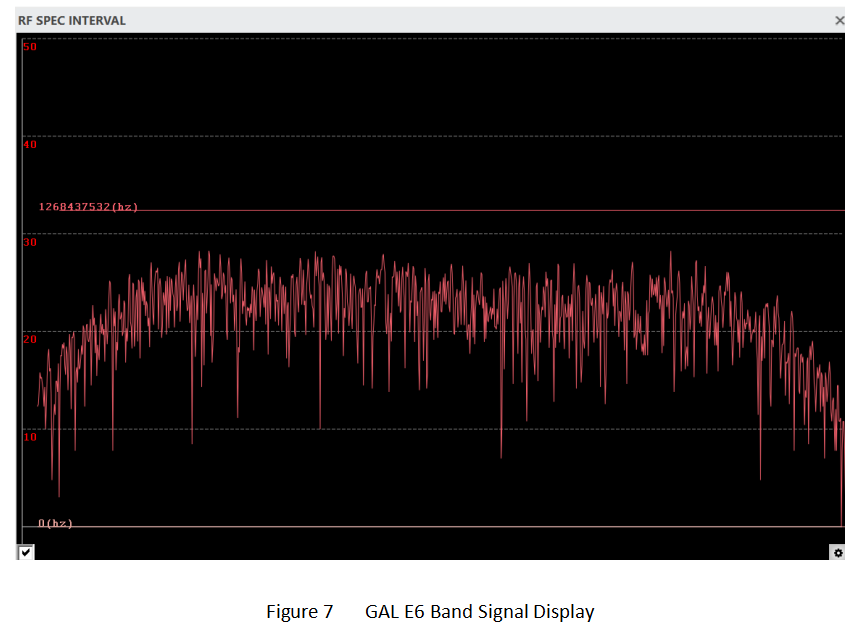
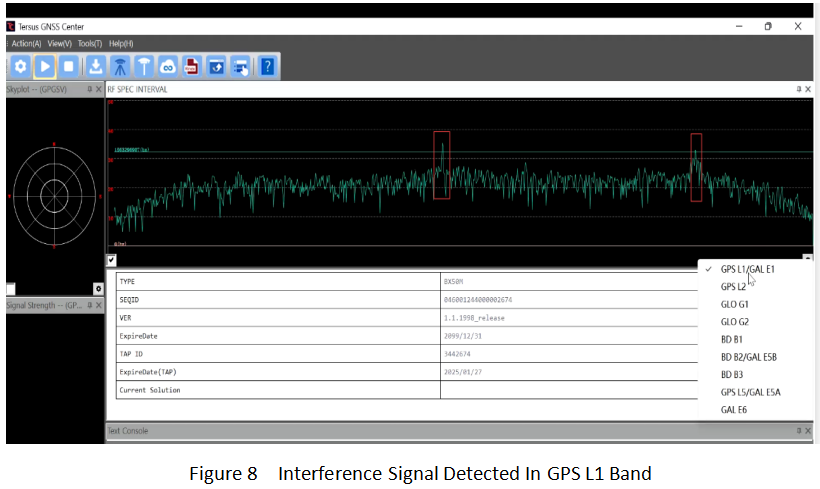
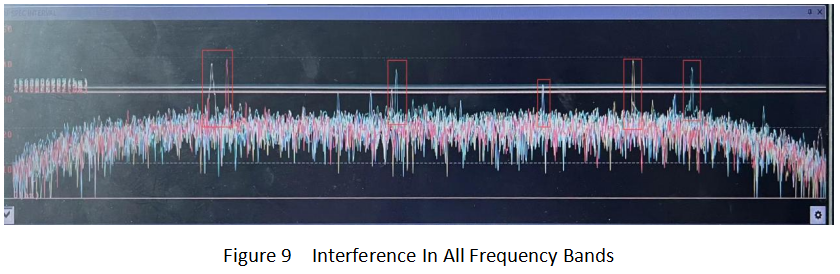
If there is interference in a certain frequency band, the software shows that the waveform of the frequency band exceeds the horizontal line in the center of the screen. As shown in Figure 8, the interference signal was found during an actual customer test. The red box shows a waveform exceeding the horizontal line, indicating interference in the GPS L1/Galileo E1 band. Figure 9 shows the interference status across all frequency bands.
Summary: Adapt, Overcome, and Never Stop
Because of their characteristics and advantages, GNSS systems are increasingly becoming indispensable to advanced equipment, high technology, and people’s needs for a better life. The number of electronic and electrical devices that can interfere with GNSS signals is also increasing rapidly with the needs of daily life and production. We have to accept and adapt to the reality that we are increasingly dependent on GNSS systems and that interference with GNSS signals is also increasing day by day.
Adapting to reality does not mean doing nothing. Tersus has ten years of anti-interference experience in design, R&D, manufacturing, and after-sales processes, covering hardware, software, algorithms, and other areas. This experience and strong anti-interference technology ensure that Tersus boards and receivers can maintain high accuracy and reliability in complex and extreme environments, meeting high-precision GNSS positioning needs in various scenarios.
In the foreseeable future, new interference sources will continue to emerge, placing higher demands on manufacturers’ anti-interference capabilities. Tersus will continue to improve its anti-interference capabilities, address new interference sources, optimize anti-interference processes, enhance anti-interference technology, and provide better anti-interference services.
References
[1] Yuelu Zhao, Lei Ji. Research on narrowband interference suppression algorithm for navigation satellite receivers. Electronic Science and Technology, 2016, 29(3): 53–57.
[2] Jia Qiongqiong, Wu Renbiao, Wang Wenyi, Lu Dan, Wang Lu. GNSS adaptive interference suppression algorithm for high-precision measurement. Journal of Electronics, 2018, 11: 2753–2760.
[3] Li Yuying, Wang Yanpeng, Wang Xing. Evaluation of the algorithm index for anti-narrowband interference in the intermediate frequency domain of satellite navigation receivers. Science and Technology, 2018, 25: 75–76.
[4] Bi Xiaojun, Shao Ran. Narrowband interference detection in OFDM system based on adaptive matching pursuit. Journal of Harbin Engineering University, 2014, 07.
[5] Dai Rui, Wei Jiancheng. Research on frequency-domain anti-narrowband interference algorithm for satellite navigation block processing. Modern Navigation, 2023, 1: 1–4.
[6] Zhang Zhaolin, Li Lu, Yao Rugui, Wang Ling. Narrowband interference detection technology based on LMS algorithm. Journal of Northwestern Polytechnical University, 2016, 34(1): 92–97.
[7] Hao Wang, Qing Chang, Yong Xu, Xianxu Li. Adaptive Narrow-Band Interference Suppression and Performance Evaluation Based on Code-Aided in GNSS Inter-Satellite Links. IEEE Systems Journal, 2020, 14(1): 538–547.

