To achieve high-precision positioning, it is essential to consider not only the accuracy of the satellite system itself but also the impact of factors such as the DOP values.
To achieve high-precision positioning, it is essential to consider not only the accuracy of the satellite system itself but also the impact of factors such as the DOP values.
Definition
DOP, which stands for Dilution of Precision, is a metric that assesses the impact of the geometric distribution of visible satellites in a navigation system on the accuracy of positioning. It evaluates the reliability of a receiver's position by considering the geometric arrangement of satellites in the sky. When navigation satellites are closely positioned in the sky, the geometric configuration is weaker, resulting in a higher DOP value.
Conversely, when satellites are positioned farther apart, the geometric configuration is stronger, leading to a lower DOP value.
A simple example
The blue shaded area represents the measurement error of two satellite signals, while the gray shaded area represents the uncertain region of the receiver's position.
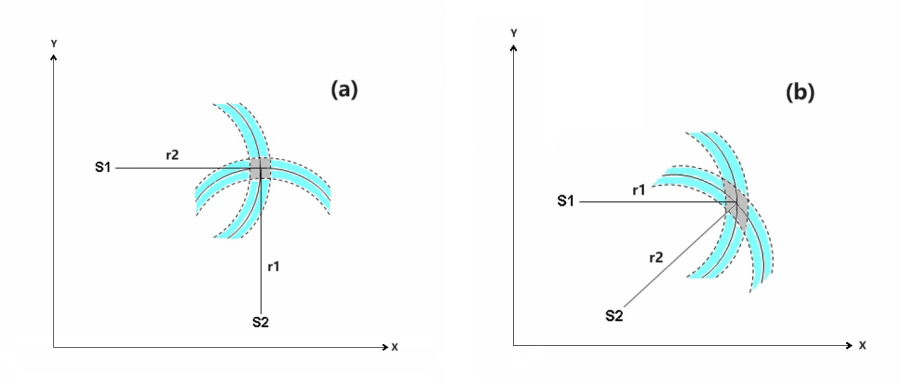
In Figure a: S1(Satellite 1) is positioned orthogonal to S2, so the receiver can determine x and y coordinates with the same accuracy, resulting in a small area of position uncertainty (low DOP value). In Figure b: S2 is closer to S1, leading to a significantly larger area of position uncertainty (high DOP value), with the confidence in the Y coordinate being smaller than the X coordinate. We consider the accuracy in case b is diluted in comparison to that of case a.
Therefore, a low DOP value represents better position accuracy.
Different meanings represented by DOP values
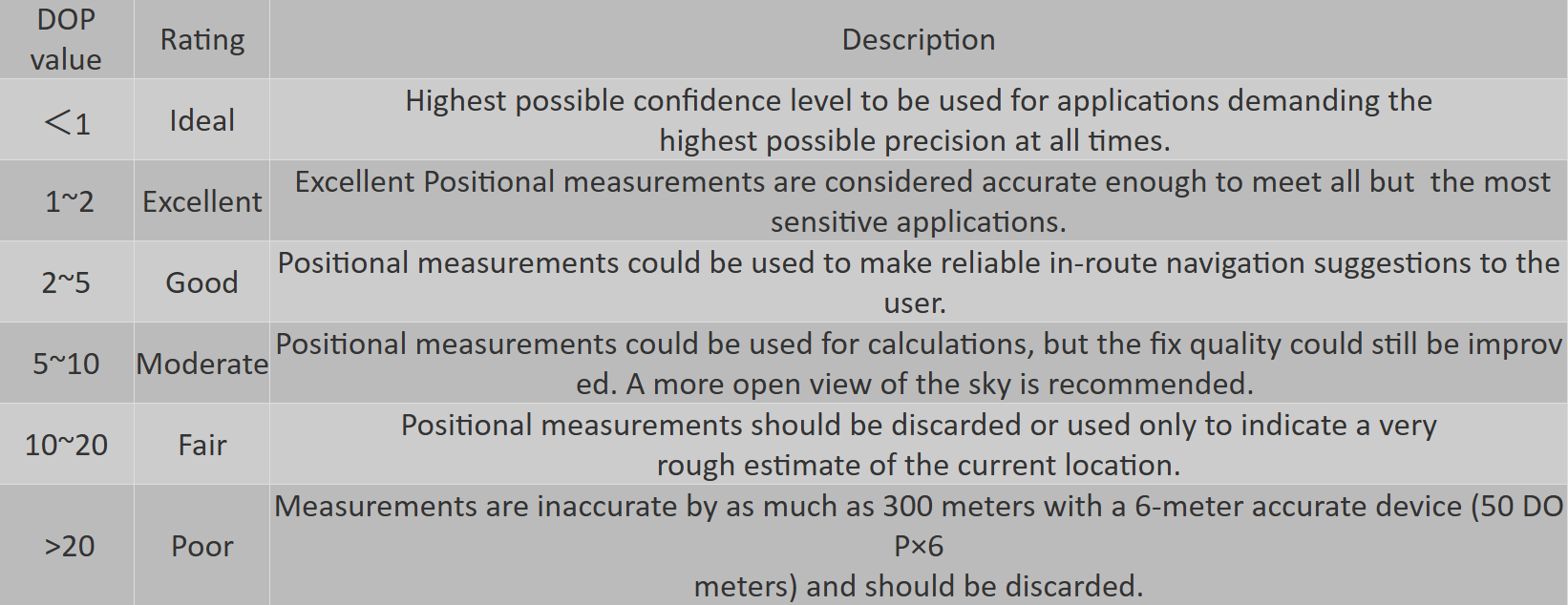
Several DOP measurements with different definitions
◆ HDOP: Horizontal Dilution of Precision, measures how the geometric distribution of satellites affects the accuracy of the horizontal position, which refers to the longitude and latitude. A smaller HDOP value indicates higher precision in horizontal positioning.
◆ VDOP: Vertical Dilution of Precision, evaluates how the geometric distribution of satellites impacts the accuracy of the vertical position, such as altitude or elevation. A smaller VDOP value signifies greater precision in vertical positioning.
◆ PDOP: Position Dilution of Precision, assesses how the geometric distribution of satellites affects the accuracy of positioning in terms of longitude, latitude, and altitude. It reflects the positioning accuracy related to the spatial geometric distribution of the measured satellites. A larger spatial distribution results in a smaller PDOP value, which leads to higher positioning accuracy, an ideal state is typically achieved with a PDOP value of less than 3.
While a higher PDOP value indicates lower positioning accuracy.
◆ TDOP: Time Dilution of Precision, assesses how the geometric distribution of satellites impacts the accuracy of time-based positioning. It primarily considers the effect of time measurement errors on positioning accuracy, making it crucial for applications that require precise time synchronization.
◆ GDOP: Geometric Dilution of Precision, is a significant factor in measuring positioning accuracy. It represents the magnification factor of the distance vector between the receiver and satellites caused by GNSS ranging errors. GDOP takes into account the impact of the geometric distribution of all visible satellites on positioning accuracy, making it the most fundamental and comprehensive metric among all DOP types.
A good geometric accuracy factor means that satellites are not concentrated in one area and are evenly distributed in different directional areas. A higher GDOP value indicates poorer positioning accuracy.
How to reduce DOP value?
1.Choose a better location for positioning: Avoid areas with heavy obstructions such as tall buildings, mountainous terrain, or dense forests for positioning to ensure that the receiver can receive satellite signals effectively.
2.Utilize multiple GNSS systems simultaneously: Simultaneously using satellites from multiple GNSS systems to improve DOP values and enhance positioning accuracy.
3.Increase the number of visible satellites: Improve the geometric distribution of satellites by increasing the number of visible satellites, thus reducing DOP values.
4.Ensure timely updates of ephemeris data: Keeping ephemeris data up to date to ensure the receiver has accurate information about the position and status of satellites .
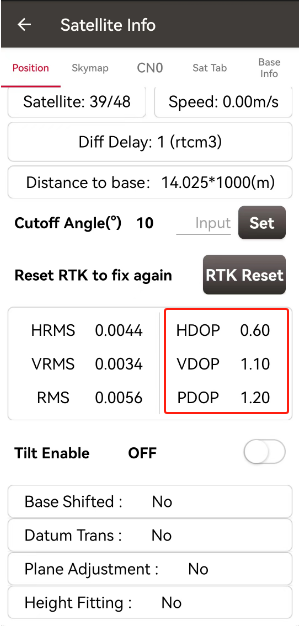
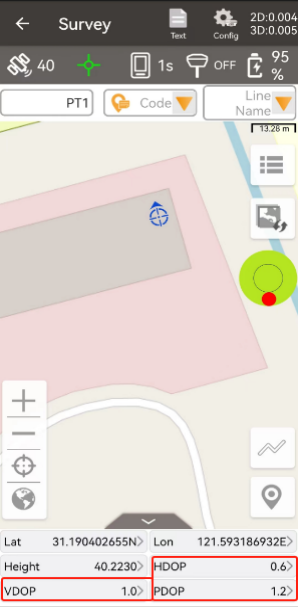
Where to find DOP in Nuwa?
The values can be found in the survey interface or the details page of the positioning information.