


With the advancement of Global Navigation Satellite Systems (GNSS), the demand for real-time centimeter-level positioning has become increasingly urgent in fields such as autonomous driving, precision agriculture, and marine surveying.
Evolution of High-Precision Positioning Technology
With the advancement of Global Navigation Satellite Systems (GNSS), the demand for real-time centimeter-level positioning has become increasingly urgent in fields such as autonomous driving, precision agriculture, and marine surveying. Traditional Real-Time Kinematic (RTK) and Precise Point Positioning (PPP) each have their advantages and limitations:
- RTK: Relies on local base station corrections to provide instantaneous centimeter-level positioning. However, its coverage is limited, requiring a dense network of base stations and a stable data link via the internet or radio transmission.
- PPP: Requires only a single receiver for global coverage, but the convergence time is relatively long, typically around 30 minutes, making it unsuitable for real-time applications.
To address these challenges, innovations such as PPP-AR, Fast PPP-AR, and PPP-RTK have emerged, combining the strengths of both approaches.
Concept Analysis
1. PPP-AR (Precise Point Positioning with Ambiguity Resolution)
PPP-AR enhances traditional PPP by resolving carrier phase ambiguities (Ambiguity Resolution, AR) to improve positioning accuracy. Traditional PPP solutions treat ambiguity as a float solution, while PPP-AR applies Uncalibrated Phase Delay (UPD) corrections to fix ambiguities as integer values, significantly improving convergence time and accuracy.
Key Technologies
- A global network of reference stations providing high-precision satellite orbit, clock corrections, and phase bias data, enabling integer ambiguity resolution.
- Perform modeling or parameter estimation of the ionosphere and troposphere; eliminate partial effects through linear combinations of observables from dual-frequency receivers.
Advantages
- Higher accuracy: Improves precision from decimeter level to centimeter level.
- Faster convergence: Reduces convergence time to within 15 minutes.
Challenges
- Signal obstruction: L-band satellite signals are susceptible to blockage, making convergence difficult in urban canyons or other obstructed environments.
2. Fast PPP-AR
Fast PPP-AR further optimizes the convergence time of PPP-AR by enhancing model robustness and refining the ambiguity resolution strategy through the optimized combination of multi-frequency observations. Its core technologies include:
- Multi-Frequency Combination Optimization: By optimally integrating multi-constellation and multi-frequency observations (such as triple-frequency), ambiguities are progressively resolved and errors suppressed. This approach increases observation redundancy, enhances the success rate of ambiguity resolution, and significantly shortens convergence time.
- Ionospheric Error Correction: Utilizing ionosphere-free combination observations in conjunction with external ionospheric models or real-time estimates further mitigates the impact of higher-order ionospheric effects.
Advantages
- Lower infrastructure dependency: Requires only about a hundred global reference stations, eliminating the need for dense base station networks.
- Enhanced adaptability: Suitable for dynamic applications such as high-speed vehicles and UAVs, ensuring positioning continuity.
- Global service capability: Can be used in remote areas without terrestrial networks, such as oceans and deserts.
Challenges
- Signal obstruction issues: L-band satellite signals remain vulnerable to environmental obstructions, though improvements over standard PPP-AR exist.
3. PPP-RTK (Precise Point Positioning with Real-Time Kinematic Augmentation)
PPP-RTK combines PPP and RTK. By integrating State-Space Representation (SSR) corrections and regional augmentation corrections to allow single-receiver users to rapidly (or even instantaneously) achieve centimeter-level positioning accuracy.
Technical Principles
- A dense network of reference stations provides high-precision satellite orbit, clock error, phase bias and ionospheric/tropospheric delay data.
- Users receive correction data and integrate them with local observations to determine their position.
Advantages
- Ultra-fast convergence: Achieves centimeter-level accuracy within 15 seconds.
- High precision: Suitable for high-precision surveying and areas covered by CORS networks.
Challenges
- Infrastructure dependency: Requires a dense network of reference stations to generate atmospheric state parameters, increasing deployment complexity. Higher station density improves performance, making it more similar to RTK; lower density leans it closer to PPP.
- High data transmission requirements: The ionosphere and troposphere information increases data load, which requires using the Internet for additional transmission.
Comparison of Fast PPP-AR and PPP-RTK
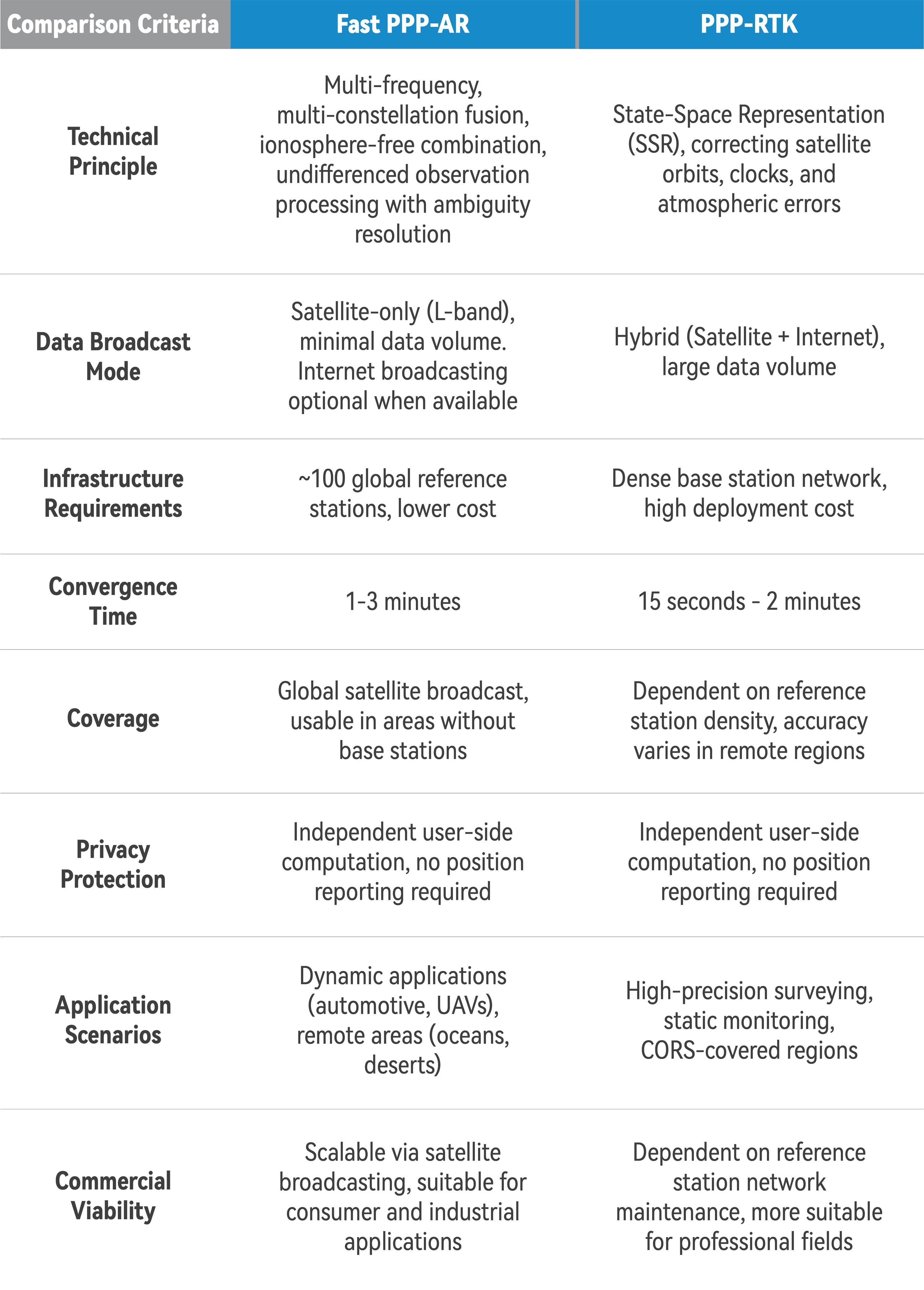
Core Advantages of Fast PPP-AR
Revolutionary broadcast mode
- Uses lightweight correction data (orbits, clocks) transmitted via satellites, eliminating dependence on terrestrial networks.
- Data compression techniques optimize for L-band satellite bandwidth, achieving “single-station global service.”
- Internet-based transmission is also available where networks exist.
Balanced cost and performance
- Sparse reference stations significantly reduce deployment costs, avoiding PPP-RTK’s requirement for high-density base stations.
- Satellite broadcasting is ideal for areas with limited or no internet connectivity, bridging service gaps.
Broad applicability
- Provides stable centimeter-level accuracy even in ionospheric disturbance-prone regions like the equator and polar areas.
- Usable in remote areas such as oceans and deserts without requiring costly ground infrastructure.
Summary and Future Outlook
Fast PPP-AR, through “multi-frequency interference mitigation + satellite lightweight broadcasting,” achieves breakthroughs in data volume and coverage, making high-precision positioning more accessible.
With the development of Low Earth Orbit (LEO) satellite constellations (e.g., Starlink, BeiDou LEO augmentation system), Fast PPP-AR is expected to further improve:
- Instantaneous convergence: LEO-enhanced signals could reduce initialization time to under 10 seconds.
- Global service enhancement: LEO constellations could further improve worldwide coverage.
- Consumer adoption: Chip-level integration could lower costs, facilitating widespread use in consumer applications.
Tersus TAP Service: A Commercial Implementation of Fast PPP-AR
Tersus has launched TAP (Tersus Advanced Positioning) service based on Fast PPP-AR, enabling high-precision positioning with a single receiver globally.
Key Features
- Centimeter Accuracy: 1.5 cm horizontal, 3 cm vertical accuracy.
- Rapid Convergence: <3 minutes from startup.
- Global Coverage: Corrections broadcast via 6 geostationary satellites, ensuring ≥2 satellites visible worldwide.
- High Availability: Redundant architecture (dual reference networks, dual data centers, 6 satellite links) ensures 99.99% uptime (<30 minutes annual downtime).
This commercial application marks a significant step in making Fast PPP-AR widely accessible, avoiding PPP-RTK’s inherent limitations in broadcast data volume and reference station density requirements, and paving the way for the mass adoption of high-precision positioning technologies. For comprehensive technical specifications of TAP services, access TAP - Tersus Advanced Positioning | Tersus GNSS.

